Calmont Wire and Cable manufactures


Friday, November 9, 2012

Medical Wire – When Quality Matters


When it comes to medical grade wire, quality is the top priority. These wires are to be installed in the equipment that will be responsible for saving lives, and as a result it needs to be up to the highest standards of quality possible. No matter the specifics of the wire itself, medical wire has to be the best it can be. There are a few basic things that go into each type of wire, and matching up these basics to your specific needs will ensure that you choose the right one for you. From shape to material, here's what you need to look at.

For starters, you'll be able to match up the shape that you need to the wire available. While most commercial or residential wire is the basic round shape, medical grade custom wire is different. Round wire and flat wire are common, but you may need stranded wire with open centers or even stranger shapes designed for the different types of applications and machines used in today's medical industry. When you need very specifically shaped wire, you'll need to go with medically shaped wire in order to get the type of wire you need for your devices.

The actual material that wire is made out of will have a big impact on a number of things including its conductivity, its resistance to corrosion or other issues, and more. From copper alloys or stainless steel to more advanced coatings like electroplated or anodized wire, there are several different options out there that you will be able to choose from. There are even wires made from precious metals including gold, silver, and platinum. No matter the type of material your medical device calls for, you'll be able to find one that matches your needs and use it without worry.

Coating or insulation is also important to consistently protect other parts of the machine and to ensure that performance is at its highest level possible. If you'll match up the basic elements that make up good medical grade wire, including the materials used, the shape, the coating and insulation, and the overall amount that you need, you'll be able to find the right wire for any medical device or any use. The quality of your wire matters, to you and to those who will depend on it when lives are on the line. That's why choosing the best is so important.

Monday, October 22, 2012

Finding Wire and Cable for Industrial Applications


Whenever you're dealing with any type of complex wire and cable solution, you have to make sure that you have the best resources available. With things like conductor stranding and other special requirements, there is a lot to take into consideration before you make any kind of investment.  Fortunately, there are several custom wire manufacturers that provide solutions to different types of wire and cable applications. For example, if you need high quality wire that will meet up to the standards required in aerospace applications, you have to find a company that specializes in that product to make sure that you are getting the best, and so on.
It doesn't matter what you have in mind when you are in the market for advanced wire and cable. You really have to take into consideration the special design and characteristics that you need from wire and cable for your project.  From this, you can contact a wire and cable company and they can advise you on the best cable for your usage or if it will require a custom design.  Many people assume that they are limited to the wire and cable that is sold off the shelf because it is more affordable, but that is not the case.  In reality, you are more likely to save money if you take the time to consult with an experienced custom wire company that can make sure you can get the most for your money.
There are hundreds of different industrial applications for specialty cable and wiring including everything from flexible wire and to high temperature cable.  Regardless of how much cable you need or how much money you are willing to spend, wire and cable experts will take the time to find a solution to your problem.  Finding an experienced, professional wire and cable company will ensure that you don’t encounter any problems in the future when putting your wire into use.
Specialty cables have a variety of different purposes out in each industry. Whether you need a wire or cable for a specific type of industry or even for a specific job, it's easy for you to find what you need when you take advantage of having custom cable manufacturers to rely on. With specialty wire and cable, your business can get what it needs and get back to work faster and with less hassle than ever before. Plus, you don't have to spend fortune cables, which is great news to everyone who assumes 'custom' means expensive.
visit http://www.calmont.com/ for more details
                                                                               

Sunday, October 7, 2012

Silicone Ribbon and Flat Cables: More Flexibility


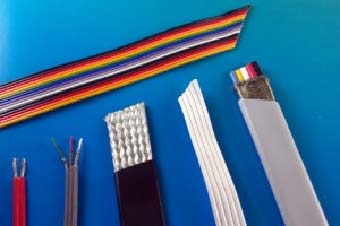
When you think of extremely flexible wire, silicone insulated wire comes to mind because of its flexible properties. But what about using silicone in ribbon cable? Manufactures turn to silicone ribbon cables when applications require flat cables with specialized requirements or extreme flexibility. Flat cables and ribbon cables are often used when space is a factor ribbon cables can also be easily mass terminated using
an insulation displacement connector (IDC). Ribbon cables are manufactured in a variety of materials and configurations including silicone; the most common and least expensive insulation is PVC.
Space is a luxury as devices become smaller. Manufacturers are using flat and ribbon cables for more applications.

Industries include:
  • Aerospace
  • Automation/Robotics
  • Medical
  • Industrial
  • Automotive
  • Telecommunication
These types of applications often need insulation materials other than PVC due to special requirements such as extreme temperature, low smoke, flammability, flexibility, sterilization and chemical contact. Silicone is an excellent choice for these types of requirements. Not only is silicone wire extremely flexible, it can withstand millions of flex cycles, and has good steam and chemical resistance. Silicone ribbon cables can be extruded or bonded depending on the type of termination that is used. Extruded ribbon cables have a tighter center to center tolerance than the bonded ribbon cable. When using a bonded ribbon cable, terminating with IDC is recommended. Extruded ribbon cables normally require tooling to control shape and pitch which may add to initial cost. Bonded ribbon cables normally do not have special tooling used.
Flat cables can be manufactured in a variety of constructions which may include zip cords, ribbon cables and flat cables with an outer jacket. Custom cables can also be constructed with shielded twisted pairs, overall shield, and with tubing or lumens. Custom flat cables are also available in smaller gauges which you cannot find "off the shelf".
Silicone insulated wire and cables do have their drawback. Silicone has poor abrasion resistance, which can be a critical problem for applications where the cable comes in contact with sharp objects.  Higher abrasion resistant formulas are available for silicone. Consult your wire and cable manufacturer regarding your application to find out the options available to you.

Tuesday, September 25, 2012

Top 3 Reasons People chose Custom Wire


Super Flexible Custom Wire
Why would anyone need custom wire?  Wire is constructed differently, it is important to use a wire that was made for your type of application. There are many reasons people turn to custom wire. Custom wire can be manufactured to meet specific requirements such as, high voltage, extreme temperatures, high flex cycles and improved flexibility to name a few.

Three of the most common reasons people turn to custom hook up and lead wire are:
  • “My existing wire keeps breaking.” Wires that break and fail are usually not designed to be repeatedly flexed or bent. High flex custom wire is normally made with high strand count conductors and sometimes with alloys. Hook up and lead wires that are off the shelf are normally available in solid core, 7 or 19 strand. This wire is intended for static installations where the wire is not required to move once it is installed and is not intended for repetitive movement and high flex applications. As the fine strands break loss of conductivity and complete failure will occur. High strand count conductors will withstand this type of environment due to the construction and number of strands. High strand count wire can sometimes be purchased off the shelf, but in most cases need to be purchased from a custom wire and cable manufacturer. Custom lead wires can be manufactured with the application in mind using materials intended to withstand movement such as robotic /automation, handheld devices, and other applications.
  • “I need a more flexible wire for my project.” Ultra flexible wires are are manufactured using very high strand count conductors and flexible insulation and jacket materials which are hard to find ready-made and off the shelf. Custom wire and cable manufactures specializing in super flexible wire and cable can assist you with your flexibility requirements. There are several types of insulation that can be used to make a wire extremely flexible. Silicone insulated wires are probably the most flexible wire available together with high strand count conductors the wire can be extremely limp even described as “noodle wire” even in the larger gauge sizes.
  • “I can’t find the wire I need anywhere.”  This is usually the case when a small gauge wire is needed, retrofitting and repairs, or a wire becomes obsolete.  Wire gauges smaller than 30AWG can be difficult to find off the shelf, turning to a custom wire manufacturer that works with small gauges is usually the only option. Custom wire can be made smaller than 50AWG by some custom wire manufacturers.  Often we have requests for hookup wire and cables for equipment that needs to be repaired, updated, or overhauled. This type of situation the existing wire can’t be identified or the existing wire needs to have improved performance. Custom cable manufacturers can reverse engineer existing wire and suggest better construction or materials to achieve the improved performance and longevity of the wire.
Contact a custom wire and cable manufacturer to find out if a custom wire is needed for your application. Starting out with the right wire will save time and money in returns, repairs and redesign. They may tell you that a custom wire design is not needed and an off the shelf wire will work just fine for your application.

Thursday, September 20, 2012

Custom Wire and Cable Made to Your Specifications


Custom wire and cable is needed more often than not. There are a variety of reasons design engineers turn to custom wire and cable for their projects, but the main reason is simply they cannot find a ready- made cable that meets all their requirements.

Unique requirements may be as simple as needing:
  • Very small or odd gauge wire.
  • Special materials.
  • Unique construction.
  • More flexibility.
  • Custom colors, jacket finish, or custom printing.
More complicated custom cable requirements may involve complex construction such as, composite cables or hybrid cables. Many applications have unique requirements that can only be met with a custom cable made specifically for that application.
Getting started with a custom cable design.
Custom wire and cable manufacturers take the application into consideration when designing a custom cable. The more your custom cable manufacturer knows about the environment and usage of the wire and cable the better the performance of the custom cable will be.
Gather your data.
Have all the information about your project ready and include as much information as possible. You may not have or know all the information your cable manufacturer should be able to assist you.
Information to have:
  • Number, size and plating of conductors
  • Cable O.D.
  • Voltage, operating temperature
  • Impedance, EMI requirements
  • Other requirements- Certifications, bio-compatibility, flex cycles, flammability.
  • Include a description of how the cable will be used.
Don't forget to include small details like jacket finish (matte or glossy), custom colors, smooth, etc...
Finding a custom cable manufacturer.
The wire and cable industry is relatively small. Get a recommendation from your contract manufacturer, industry friends and even Google. Each custom cable manufacturer has their own specialty or niche. Be sure your cable manufacturer has experience with the type of application you are working with for example, aerospace/space cables, low smoke materials, medical cables, implantable wire and cable and others. Experienced in manufacturing for your type of application will save you in delays and problems down the line.
When you get a quote from more than one, make sure the cable designs are similar. If not, find out why.  It is always a good idea to compare the designs and cable components and ask questions in ensure nothing was missed with your custom cable design.
Custom wire and cable advantage
The benefits of using a custom cable over a readily available cable are many. The two main benefits of using wire and cable designed specifically for your product is going to outlast and outperform an off the shelf solution in most cases.
Readily available wire and cable is mass produced to cover a wide range of usage in a variety of industries. A generic robotic cable may work well in one robotic application may not work in a medical or aerospace robotic application. Often when using generic cables concessions are made in order to accommodate the cable.


Tuesday, September 11, 2012

The Growing Importance of Custom Medical Cables


While medical devices are incredibly important in the medical world, without medical cables to run them, those incredibly important medical devices would be rendered useless. In that respect, it is already quite obvious to see why functional, effective, and reliable medical cables are an absolute necessity for an evermore technology-dependent medical field.

There are many different types of medical cables that are needed during everyday medical practices- a medical wire that connects a medical ventilator to a power source or something as simple as a medical cable that connects a specialized printer to print out custom patient reports and the like.

However, these days, the medical technologies used to treat patients have become more advanced as well as highly customized, which means that the computerized apparatus that are currently being used to treat patients need to be created from parts that have been specialized for certain procedures and applications.

Take, for example, MRI machines. Although the basic function of MRI machines are the same- to visualize internal bodily structures using a medical imaging technique- there now exist needs to tweak an MRI machine to make it capable of taking more specialized images for internal bodily structures. In order to do this, however, specialized medical cables are needed.

Just like a specialized MRI machine, there are, and will be, many medical devices that are needed for more and more specialized reasons, calling for the need for customized parts, especially cables. This is because medical cables are what powers the machines and relays information from one part of the machine to the other.

Medical cables can be composed of so many different materials such as cadmium copper, beryllium copper, and carbon fiber. But each type of material has very specific strengths and weaknesses. For example, carbon fiber has the property of being almost invisible with MRIs and other medical imaging procedures as well as the property of being radio translucent, making them the near perfect material with which to make EKG leads or wiring in defibrillators.

The complexity and variety of medical cables necessitates the need for specialists who are highly capable of creating effective and trustworthy custom medical cables. Not only does the complexity and variety of medical cables dictate a need for specialist, but the fact that a good amount of medical environments need sterilized medical devices shows that medical cables need to be made by trained and trusted specialists.

There are custom medical cable specialists who can help figure out how to develop medical cables according to virtually any specification. These cable specialists can help create custom cables and wiring for medical devices such as devices used during surgery and even specialized devices such as laser eye surgery devices and tools.

Monday, August 27, 2012

Standard and Custom Medical Wire


Every medical cable application is different so why settle for an off the shelf solution for a unique problem? I read quite a few discussion boards and find that when someone is looking for a specialized medical cable that the replies usually tell them to call Belden or Alpha. There is nothing wrong with Alpha or Belden however, keep in mind they mass produce generic wire and cable that covers a wide variety of uses and may not meet all your needs.
If you wanted to race in the Daytona 500, would you go to your neighborhood car dealer and buy a generic automobile to race? Of course not, you would build a custom car with the performance to handle the racetrack conditions, the type of race and your driving style. The same applies to medical cables, Your requirements are specific to your application which may include size, number and type of conductors, bio-compatibility, sterilization techniques or even a custom colored jacket.  Custom medical cables are designed specifically for your requirements and type of use.
Often for new designs and products, a small quantity is needed for prototypes, proof of concept or testing. Custom medical cable manufacturers understand this and normally have the capabilities to manufacture small runs of custom wire and cable. If your medical cable design is simple, ask your custom cable manufacture if they have any sample stock or over runs in stock that match your cable requirements.
Get the right cable for your medical device by contacting a medical cable manufacturer and discussing your needs and application. The more the cable manufacturer knows about your needs the better your design will be suited for you.
What to tell your custom medical cable manufacturer:
  • Type of use – How the medical device will be used, the environment, will the cable be subjected to repetitive flexing, high temperatures or abrasion?
  • Sterilization – Is the cable reusable or disposable? Will the cable be sterilized? If so how and how many cycles.
  • Patient contact – What bio-compatibility requirements are needed? Explain the extent of patient contact with the wire or cable.
  • Mechanical requirements – Voltage, temperature, flex cycles and EMI shielding. Will the cable experience repeated bending or twisting motion?
  • Physical requirements – The number of conductors, size, plating, cable construction, shape and overall diameter.
  • Expectations – Discuss what you want for performance and product longevity. Do you expect product lifetime to be 6 months or 6 years?

Thursday, August 23, 2012

Medical Cables: What’s the difference?


Medical cables do differ from cables used in other industries. It isn't recommended to use standard/ generic wire and cable in your medical device design unless the wire or cable doesn't need to meet any medical requirements or is used internally in your device. Every industry has it's unique requirements when it comes to wire and cable. The medical industry is no exception. Medical wire and cable is readily available "off the shelf" however, many medical industry engineers turn to custom medical cables due to their application's unique requirements. What makes medical wire and cable different? Medical devices are designed to be precise whether it is for diagnostics, patient monitoring, surgical or provides imaging/video. Medical device cables may need to provide multiple functions with just one cable such as, data, power fluids or air. Medical cables can be complex or a simple design, in either case custom medical device cables offer the performance and longevity needed for this type of application.

Another unique feature of medical device cables is the insulation and jacket compounds are formulated to meet the specific requirements of medical applications such as:

  • Sterilization - Sterilization techniques include autoclave, E-beam, chemicals to name a few. What insulation and jacket materials can withstand do vary and it is important to take this into consideration when designing your medical device. Sterilization properties chart is a helpful tool, but discussing your requirements with a custom medical cable manufacturer can save you research time.
  • Bio-compatibility - Patient contact is another requirement for medical device cable. Contact can be from exterior to implantable. Medical wire and cable jacket compounds are available in many grades and the extent of patient contact should be discussed with your medical cable manufacturer.

Disposable or reusable?

Disposable cables are normally used for a limited usage and do not undergo repeated sterilization before being disposed. Disposable wire and cable are made of less expensive materials such as PVC. Reusable medical cables normally have to withstand anywhere from hundreds to over a thousand sterilization cycles.

Medical device wire

Medical device lead wires can also differ from generic wire. Sensors and monitoring devices are becoming smaller, wireless and their functions are more complex. Patient monitoring devices often require lightweight, small gauge, ultra flexible wire for patient comfort while being monitored. Patient monitoring devices are sometimes worn for long periods or even implanted. The need for small extremely flexible wire is becoming more evident with these types of medical applications.

A few examples of long term patient monitoring include:

  • Fetal monitoring devices - Fetal monitors can be wired to a receiver or wireless for extended monitoring. The monitor is connected to a unit which sends information to a receiver allowing the patient to move freely. Small gauge very flexible wire and cable is used for this type of product.
  • Sleep monitors - Patient comfort is important with this type of device. The ultra flexible wire need to be lightweight and a small gauge using flexible insulating materials such as TPE or silicone.
  • Heart monitors - This type of long term device normally uses cables instead of lead wires. Heart monitor devices can be connected to an implant then to a battery/power pack or sending unit which sends information to a receiver/recorder. Cables may be required to send data, supply power, be flexible and be resistant to abrasion and cleaning solutions. Other types of heart monitors may be connected to sensors externally on the body for extended periods.

When considering your medical device wire and cable for your product be sure to speak with a custom medical cable manufacturer to find out what materials and construction will work best for your device.

Thursday, August 9, 2012

High Voltage Wire- Robotics Wire Solutions


When you are in the market for robotics wire, it will be easy for you to find everything that you need if you know where to look. High voltage wire is a specialty item, but it is available online and you have many more options than you might have before. Getting your hands on the latest technology in wiring for robotics and other high-tech applications isn’t difficult as long as you take the time to look. Use the internet to your advantage to learn everything that you need to know and then some.

Robotics wire is used in many robotics and technology applications. There are a variety of different uses and industries that rely on this type of solution, allowing everyone to take advantage of technology in different ways. The most common industries include: healthcare robotics, military robotics, consumer robotics, and industrial robotics. Of course, whenever you need this type of high voltage wire, the application doesn’t matter so long as you find the right solutions and brands for your needs.

This isn’t something that you can just buy at the local hardware store. You really have to take the time to find specialty robotics wire solutions. These professionals know all about applications for this wire, how to buy it, and which styles and types are most in-demand. There are a lot of considerations that you have to think about when buying high voltage wire, including things like:

-Durability

-Flexibility

-Lifespan

-Strength

With the best wires, you will be able to trust that you are getting what you deserve. The wires should be made from specially compounds and materials that are placed over high-strength stranded alloy wires. It doesn’t matter what you have in mind because you can find twisted pairs, coaxial cables, hookup wire, silicone wire, and other solutions online.

Engineers and anyone working with welding or painting robots, rotary tables, conveyors, animatronics, or pick-and-place devices will be able to see the value of this type of wire. Robotics wire comes in all shapes, sizes, and lengths to give you everything that you deserve out of your investment, no matter what you have in mind. Make sure that you take the time to figure out exactly what you want and need because the internet makes it easy for you to get the best high voltage wire for every application, no matter what you have in mind.