- Aerospace
- Automation/Robotics
- Medical
- Industrial
- Automotive
- Telecommunication
Sunday, October 7, 2012
Silicone Ribbon and Flat Cables: More Flexibility
Wednesday, July 25, 2012
High Voltage Wire and Cable: What you need to know before you buy
• Current capacity- To determine the cross-section size of the conductor(s)
• Environment- Temperature, chemical, UV exposure and mechanical impact to determine the cable construction and material of the outer jacket.
High voltage wire has two factors which require special attention. The first is the type of insulation needed to prevent arcs to nearby components, wiring or people. The other is the insulation diameter necessary to reduce corona loss. Reduction of corona is important because a common high voltage problem for insulation is damage to the insulation caused by corona discharge resulting in pinholes. With all high voltage applications, it is important that the insulation of the cable not deteriorate due to the high voltage stress.
Why co-extrusion?
Corona resistant wire (HVCR) is typically constructed with a conductor surrounded by a semiconducting sheath, which is then surrounded by the insulation. The semiconducting sheath effectively increases the diameter of the wire, reducing the tendency for corona discharge. Co-extruded wire and cable are common for many high voltage applications for it's ability to effectively reduce corona. Co-extruded wire is the same construction with the semi-conductive layer and outer jacket are extruded simultaneously. The co-extrusion process prevents air and gaps between the conductor and insulating layers thus reducing if not eliminating corona.
Custom wire and cable manufacturers can assist you with material choices and cable construction based on your high voltage requirements. Having the right cable from the start will save time and money down the line.
Thursday, March 1, 2012
Silicone Ribbon and Flat Cables: More Flexibility
When you think of extremely flexible wire,
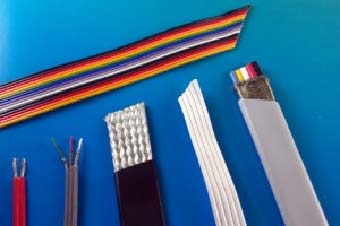
silicone insulated wire comes to mind because of its flexible properties. But what about using silicone in ribbon cable? Manufactures turn to silicone ribbon cables when applications require flat cables with specialized requirements or extreme flexibility. Flat cables and ribbon cables are often used when space is a factor ribbon cables can also be easily mass terminated usingan insulation displacement connector (IDC). Ribbon cables are manufactured in a variety of materials and configurations including silicone; the most common and least expensive insulation is PVC.
Space is a luxury as devices become smaller. Manufacturers are using flat and ribbon cables for more applications.
Aerospace
Automation/Robotics
Medical
Industrial
Automotive
Telecommunication
These types of applications often need insulation materials other than PVC due to special requirements such as extreme temperature, low smoke, flammability, flexibility, sterilization and chemical contact. Silicone is an excellent choice for these types of requirements. Not only is silicone wire extremely flexible, it can withstand millions of flex cycles, and has good steam and chemical resistance. Silicone ribbon cables can be extruded or bonded depending on the type of termination that is used. Extruded ribbon cables have a tighter center to center tolerance than the bonded ribbon cable. When using a bonded ribbon cable, terminating with IDC is recommended. Extruded ribbon cables normally require tooling to control shape and pitch which may add to initial cost. Bonded ribbon cables normally do not have special tooling used.
Flat cables can be manufactured in a variety of constructions which may include zip cords, ribbon cables and flat cables with an outer jacket. Custom cables can also be constructed with shielded twisted pairs, overall shield, and with tubing or lumens. Custom flat cables are also available in smaller gauges which you cannot find "off the shelf".
Silicone insulated wire and cables do have their drawback. Silicone has poor abrasion resistance, which can be a critical problem for applications where the cable comes in contact with sharp objects. Higher abrasion resistant formulas are available for silicone. Consult your wire and cable manufacturer regarding your application to find out the options available to you.
To find out more about flat cable options or if silicone cables are right for your application contact Calmont for assistance with your design or request a quote. Feel free to leave a comment.
Wednesday, February 22, 2012
Silicone wire: Art Using Custom wire and Cable
Custom wire and cable in art? One usually doesn't think of custom cable and art. From time to time we are contacted by artists looking for custom wire and cable for their art projects which are usually in the way of sculptures. Often times the custom wire is part of the art piece. In 2007 Claude Zervas an artist in the Seattle area needed an extremely flexible wire for an electronic art piece he was working on. The flexible custom wires needed to be placed in a way to be aesthetically pleasing and not to take away from the art piece as the wire becomes a part of the art. "Since the wire is often exposed and becomes a formal part of the sculpture it needs to have certain physical properties such as color and flexibility. The high flex silicone insulated wire is perfect since it resists kinking and drapes like string or rope" says Claude.
His challenge was "off the shelf" wire was too stiff and could not be draped and arranged properly. The wire Claude chose is a silicone insulated wire with a high strand count conductor. This is an extremely flexible wire which was easy to incorporate into the art piece. Silicone insulation is used in a variety of industries and applications requiring super flexible wire, high voltage or high temperature.
The silicone wire was used in a sculpture commissioned by the King County Arts Commission for the exhibition hall at the Brightwater Treatment Facility (pictured on left). Happy with the performance and look of the wire, he has been using the silicone wire for other art pieces as well.
The photos below illustrate the layout and a close up of Claude's sculpture. The silicone wire plays a part in the design and function of the art piece.
"Diatomoton 5" The layout A closer look at Diatomoton 5
Here's a video of Diatomoton 5 in action:
About Claude
Claude Zervas' artwork uses technology and a variety of media to explore representation of landscape, social ecology, and memory. He creates 2D, 3D, and time-based work using video or custom computer programs. He has stated, “I grew up in a rural part of Whatcom County and I have been greatly influenced by the physical landscape, the social topology, and the transformation of this region. I am interested in how the idea of place evokes emotion, the way emotion affects memory and how memory in turn affects perception.”
After attending art school at Western Washington University Zervas fell into a career as a software engineer, eventually returning to art full-time. He leverages many of the skills acquired from his engineering experience to produce his art. Click here to see more examples of Claude's art.
If you have questions or an application requiring custom wire or cable contact Calmont for assistance. Please feel free to comment or share this article.
D5 from Claude Zervas on Vimeo.


